Friday, 1 April 2011

Diego's Dream: First steps and great challenges

I really like changes and challenges, but the one I was about to experience was something brand new. Some say you need to feel like you have a command over your challenge before achieving, but for me this was not the case. November 2010, I started training to become the new assistant operations manager at Otra Cosa Network. So, this is me, Diego Velasquez Pastor*, a young Peruvian guy preparing for an amazing job and at the same time a huge duty. Now you may wonder, how did I come across this opportunity?

It was a cold October and I was about to finish my 9th semester at the National University of Trujillo. When searching for jobs on the internet, I found a posting from OCN and it caught my eye. I put everything else aside because the ad was in English, my beloved second language, the one I try to improve every day. “Otra Cosa” is also the name of my favorite record from Mexican singer Julieta Venegas. A sign? I thought so and decided to apply! For one week there was no response which devastated me considering most Peruvian recruiters call right away to arrange a personal interview. Some people even get the job that same day. I didn’t know at the time that Otra Cosa is an alternative NGO and they would have a unique and personal interviewing process.

Two weeks later, Najin Kim, OCN operations manager sent me an e-mail. She asked me to come by the office the following week for a personal interview. It was a Friday and as soon as I stepped foot into the office I felt the great vibe and their professionalism. Najin and I talked about my resume and OCN expectations. She made me write a couple essays. I waited for a whole other week. Finally, she emailed me again to arrange a Skype interview with the directors: Juany and Peter Murphy. I was feeling sick that day, a bad cold. I was afraid I couldn’t speak loud enough for them to hear me. I was glad that they did. They were very polite and nice while asking me very specific issues. Once again I waited another week and to be honest, whether it was my sickness or the long time they took to do this selection, I started to become negative about it all. Maybe they are not going to choose me. Maybe they are looking for someone older. Maybe I didn’t fit their mold. Maybe…

On another fine Friday, Najin called me to tell me they wanted me to join the ONC team. I remember taking the phone call next to my window, it was a sunny day. I knew it was another sign that I was on the right track. Thank God, I stuck through it all. I´m amazed by the chance I have every day to work on something I really enjoy. However, it is not an easy job. It takes a lot of time planning things, thinking of them, dreaming of them and smiling when they work out as expected and needed. At times there is a lot of information to process and plenty of things to get done; you always have to be ready to change plans at the last minute. We work with and for volunteers, local social projects and international partners; we learn new ways to improve procedures, but our main rule is flexibility, moving in like the waves on the sea. It’s funny and so true when Najin called it “organized” chaos. From Juany and Peter Murphy to our local collaborators, we all work with passion. And we don’t mind getting tons of sand in our sandals as long as we can make a difference in people’s life. We do our best to give everyone hope and the best reward for us is seeing that everyone understands this and appreciates it.

I`m writing this article from the OCN office and it`s so inspiring to see the garden glowing under the sun as usual. I’m sure I’m going to stay here for a long time. Obviously lots of things have changed since I first got the job. We’re growing in a very fast way, like a caterpillar shedding its cocoon. Human beings and organizations need to shed their skins to find better ones. The first trimester of 2011 is almost over and a new shiny day has come for Otra Cosa Network, we hope to not only keep getting better, but also fill the fresh air with social awareness of the crucial work we love to do.

By Diego Velasquez from Peru (OCN, from Nov. 2010 - June 2011)

Thursday, 9 December 2010

Realizing Chantal's Dream

My dream was to live and work in a Peruvian community. I wanted to get to know the culture, the people, and to see and feel how they live. To contribute to the community and help out where they needed my help, I was sure that volunteering was an effective way of doing this, as I always like to jump into new experiences, and commit myself fully to whatever I do.


I contacted Otra Cosa Network because one of my best friends had worked as a volunteer with them. She highly recommended the organization. Indeed, from the first contact, I had a good feeling about it. For me it was very important that the volunteer organisation is honest and personal. After a couple of conversations they offered me a new project, which suited me very well. That’s why I chose this new project. I was the first volunteer! I felt privileged to explore, being the first one to start contributing at Casa Hogar in Rodriguez de Mendoza. The contact I had with Najin, Operations Manager of the organization, throughout my stay at the project really supported me.


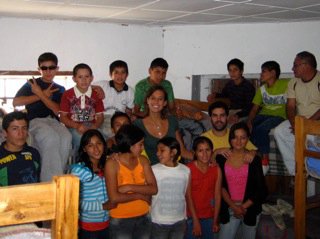
Casa Hogar San Fransisco is a warm home for children from 12 to 16 years old whose families live far away in the mountainous or jungle regions of Peru. This place offers these children the opportunity to go to school. Without Casa Hogar, the voyage to school would have been impossible. It usually takes around six hours of travel (each way!), combined by bus with trekking, for these children to get to the nearest school.

The children live together with ‘El Profe’, a local history teacher who runs the place very well. Like a father figure for the children, he was loving and caring, but he can be strict as well. He teaches the kids discipline and makes sure they complete their tasks well.


Although the church has been supporting Casa Hogar as much as they can, it is mostly self sustainable. There is no money from the government or any other fund to run this place. There are vegetable garden and some animals at Casa Hogar. The kids worked for a few hours a day after school to help out in the garden. The lettuce they grew was a well sold item at the market, a good illustration of how the program works.


I was amazed by the responsibility those children had at such a young age! They cooked by themselves on the weekends, and they washed their own clothes. They worked in the garden, and they went to the market to buy and sell food - all of this other than all of their school work! The days were long, but the kids had a lot of fun too! They played volleyball and soccer while listening to music from the radio during their free time. They are like a big family together.

When I arrived on the 3rd of July, the Padre Lolo welcomed me. He is the priest of this little town and the coordinator of Casa Hogar. Mendoza was a very nice, friendly little village. For me it was like walking into a movie. The people lived like half a century back in time compared to the Netherlands. Imagine lacking hot water, washing machines, TV, refrigerators….often water or electricity. This was very different to me.


My task was to teach the kids English. Because of the busy schedule the kids had, the evening was the best time for them to attend the English class. So every day from 8:00-9:30 pm all fourteen kids participated in the class. This, after the full days the children had. 6:00 am wake up, feeding of the animals, 7:00 am breakfast 7:30 go to school, 1:30 lunch, time for home work and then they worked in the garden until 17:00 pm, some free time, 19:00 pm dinner, and then English!


We had a lot of fun together! Because I was living with the children at Casa Hogar, I could manage to build a positive relationship with them in a short period of time. They were all very motivated, and enthusiastic to learn! Being a teacher in Holland, I have had many different groups of students of all ages but, this group in Casa Hogar was very special and unique. Kids in my country are much more spoiled with toys, computers and the protective love of their parents. Without similar amenities, these kids were very happy! I saw that in their eyes. When I was teaching them English, they taught me, without even realizing, that you can be very happy even if you don’t have much.

We sang English songs together, like ‘We are the world’ by Michael Jackson. I tried to play as many games with them as I could. Any attempt to make the learning more fun and easy was enticing.

When you live with the children in such a home, you are not only there to teach English. You become a mother, a friend, and a role model of the children as well. The girls often came to me to share moments, to ask questions about my life, to listen to music, and to talk about their lives and boyfriends. Of course they were young teenagers! It seemed that girls there don’t talk with their mother about sexuality or anything emotional. It really touched me, the trust they had in me to talk so openly about these things.


Highlights of my tasks at the project for me were teaching English and the contact I had with the children. It was not just about teaching them foreign language, but it was the interaction you have with them as a foreigner, as a role model - someone they can trust, which is very important for people at this age. For these children, it is also making their world a little bit bigger, and it also gives them an opportunity to grow. Giving them the ability to study and to make other choices for their own future is highly rewarding. I wish I had been able to extend my stay there, because the contribution you can make as a volunteer at this place is really big!

I hope the next volunteer will come soon to continue this beautiful work!


By Chantal de Jong (Casa Hogar in Rodríguez de Mendoza, from July - Aug. 2010)

¿Sόlo la Educaciόn Salvará al Perú? how about compost? - James' Volunteer Experience

Padre Tumba believes only education can save Peru. I have a different view. I believe only compost can save Peru.


Morgan and I started a composting project at the CEP school. We built two compost bins, out of recycled adobe bricks (it looks like a mini Chan Chan). Then we filled one bin with food scraps and garden waste and taught the kids all about the wonders of composting. This was our contribution to a greater Peru.

One of Padre’s visions for CEP is to be self sufficient. That is, to have a thriving vegetable garden within the school grounds that provides fresh, healthy, nutritious produce for use in the school lunches. This is an extremely practical idea and one that deserves merit as well as further volunteer attention (hint), but as you all know, the soil in Huanchaco and Trujillo is little more than sand and pebbles. This is terrible soil for growing plants. It holds very little moisture, or nutrients, both of which are essential for plant growth. That’s were compost comes in.


Compost is a free, natural source of additional soil nutrients and general all round garden improver. With compost the garden soil will be nutrient rich and grow lush, healthy vegetables. Using these nutritious vegetables in school lunches will lead to healthier children better able to concentrate and absorb knowledge. This will ultimately lead to a better educated Peru.

Without compost the garden will falta, lunches will be sparse, kids will be hungry, the famished students won’t learn, Father Tumbe’s thesis will be disproved and ultimately Peru will suffer. So for the benefit of Peru, Compost! Compost! Compost! For only education can save Peru, and only compost can save education.


Please save your food scraps, bag up garden waste around Huanchaco and give them to a CEP school volunteer. If you are a CEP volunteer, don’t be embarrassed, haul the bags of composting material on the bus and tend the pile with love, take the time to visit the compost pile, add the scraps from the school kitchen and keep the pile moist. Better yet, help the kids do all this.

Office Volunteer Jack's Experience


When I came to Huanchaco I was initially surprised how calm and quiet it was. I soon learned that words like ‘tranquilo’ and ‘poco a poco’ meaning peaceful and little by little, defined the culture here.

Arriving in late September I was able to see a drastic change in the town leading into the summer months. The coming of spring celebration started with a parade in Trujillo and the Peruvian culture and pride were vibrantly displayed. In November things started to vary. Every weekend more and more people crowded the beaches. Every day a new restaurant opened inside someone’s house. Staying in a pseudo home stay my neighbors were some of my closest friends. Playing zappo, a traditional Peruvian drinking game, every Sunday was some of my best Spanish practice with the locals. The people in Huanchaco are some of the nicest I’d ever met. At a bar in the States when a foreigner sits down and attempts to speak broken English with someone, that person wouldn’t talk to him very much. The average American certainly would not share their beer with this person. In Huanchaco the opposite is true. They want to hear your broken Spanish and to share with you. This characteristic of the pueblo was my favorite, and also the one I will take away with me.

Volunteering in the office, I was able to see the inner workings of a non-governmental organization. Over the course of my three months I was given a variety of tasks. These ranged from specific paperwork, to more open ended input into the marketing approach of the company, to traveling to the specific projects to gather information. Although I recommend that the future office volunteer has more skills with html I was able to make it work without much knowledge of the language. The deadline and timetables were kept in Peruvian time, a little bit slower than the rest of the world, but I was eventually able to find my focus and complete the task work.

As the office volunteer I was able to view all of the volunteer opportunities that Otra Cosa Network offers. This allowed me to choose where I wanted to give extra support by picking the projects that appealed to me. I started with Juan Carlos at the skate ramp project in El Cerrito. Being one of the poorest neighborhoods in Huanchaco there is very little for the kids there to do. We built the floor for a future classroom and opened the half pipe for the kids to come play on. I also became the janitor/handyman at the CEP school. Local workers and volunteers built the school. They left all the building materials and tools scattered all over the place, not a safe environment for a school with almost 300 kids. There was loads of trash lining the walls of the school as well. After about a month the place was a lot cleaner. I also got to play with the three and four year olds a bunch. Daniel- David with the mullet was my favorite little punk. Being the office volunteer allows you to spread your time out at other projects as part time work as well. I liked this aspect of my position tremendously and found it liberating.


Overall my stay in Huanchaco was amazing. The friends made and good times had I will remember forever. The food, the cake, and the surf to quote the menuland chef ‘que rico’. Return to Huanchaco? Definitely. Work more with non-profits? Puede ser. Did I learn a lot? Every day.

Tuesday, 13 April 2010

Jack's Experience at Tulio Herrera Leon School

In some parts of Peruvian society there is sometimes a certain level of stigma attached to having a child or relative with special needs and therefore many families tend not to send their children to school or ask for help with their upbringing. Tulio Herrera Leon is a school for blind and autistic people which was set up to help these people who may otherwise be left to look out for themselves. It is very well equipped with all the tools necessary to help the students with all manner of needs and different levels of disabilities. It also has a great team of caring and skilled teachers. In order to try and combat the prejudice in certain areas of society the school runs an out-reach program that goes out into workplaces and schools to try and get in contact with parents and also to help employers incorporate workers with vision impairment, autism and other special needs into their businesses. Many of the teachers also spend their spare time going to churches and hospitals to try and reach more parents and families that could benefit from the school.

Students of all ages are welcomed at Tulio Herrera Leon, with classes varying from full time students learning to read and write brail, to one on one “extra help” sessions for students who are currently studying in other schools and universities around Trujillo. It is a great school run by fantastic people and offering an extremely important service to its pupils and society as a whole as it is the only state funded school of its kind in the whole of Northern Peru. Despite this there is still room for many more students here. The school is free for all students, however if the parents of a student earn over a certain amount each month a small contribution may be asked for.

I have been volunteering at the school for a month now, working alongside the music teacher to help the students channel their creativity. When I first arrived at the school I was amazed at how well equipped the music room was but also recognized that the music teacher was struggling due to the amount of time each student requires. This meant that the children, some of whom have attention disorders, quite often lost concentration. Over this past month we have successfully managed to bring more direction into the music classes and help the students to be more constructive. The main way in which I have done this is through getting the whole class to play percussion together. This has proved a great way to teach the kids about rhythm as well as the importance of listening and playing alongside other people. This brings with it a greater sense of kinship and group awareness, and as a musician myself I can vouch for the sense of achievement that comes through playing together in a group of people.

I have one more month left at Tulio Herrera Leon and I am as excited about it as I was about the first month. Now that we have developed a good group work ethos in the classes through playing percussion together, I would like to use the skills of certain pupils in order to bring other instruments into the classes. There are several budding pianists in the school and I have been teaching a couple of people, including the music teacher, how to play the guitar. Whilst there are some students who struggle with basic drumming, when playing as a group they find it much easier to stay in time and so I am aiming to get the whole class playing a song with guitars, keyboards, percussion and possibly some singing as well. This is going to be a challenge for both me and the students but one which I’m sure we will overcome and enjoy.

The students and teachers make Tulio Herrera an amazing project to be involved in and I would recommend anyone who is interested in working here to give it go, as the school serves a part of society who really need their help.

Un Lugar Skateramp Project

Situated in Cerrito de la Virgen, a small town roughly a 30 minute walk from central Huanchaco, a new project – The Skate Ramp - has been put in place, with the help of Otra Cosa Network Volunteers with the aim of inspiring the local children of the community. The Skate Ramp was set up in 2010 by two volunteers - Johannes from Germany and Oliver from England – as part of the Un Lugar Surf School project. Un Lugar’s owner Juan Carlos agreed to have the Ramp built on a piece of land he owns in Cerrito, and with his co-operation the project was started. Johannes and Oliver personally raised the money needed to buy the materials needed to construct the ramp by running a blog and asking for donations in Europe. Once the money was raised these two (with a bit of help from other volunteers) set about constructing the Skate Ramp which was completed six weeks later. The Skate Ramp is used in the afternoon by children who live in Cerrito de la Virgen.

Cerrito de la Virgen is very different from what you will see if you stay just within Huanchaco. It was initially established by the Peruvian government as a town for those who had lost their homes and livelihoods due to the El Nino weather pattern which strikes The Americas once every three to seven years.

About 12 years ago this event had severe consequences for the population and infrastructure of Northern Peru. There were heavy rains inland in the mountainous regions of La Libertad which produced obstructions in the upper part of the Rivers. On this occasion the rivers flooded. The case of “la quebrada del León Dormido”, (The Ravine of the Sleeping Lion), the ravine that leads to the town of Huanchaco was one of the most critical.

The population there had worked in small farms and quarries, but the water washed away their homes and livelihoods. The Office of Civil Defence provided tents and food for the population but then had to relocate them. One of the places chosen was Las Pampas of La Virgen Cerrito. After a few weeks however support was cut off and the population were left to their fate.

Many of these people, considering that the place a desert location lacking in vital services - it was without water, sewage facilities and electricity - abandoned the idea of setting up homes there and left. Others sold their possessions and yet others took advantage of the circumstances and walled off two or three plots. This has resulted in the area being a mixture of families. There are environmental victims from the time, alongside new residents who have been acquiring land and who come from many different places. You can find there today people from the Peruvian mountains, the valley regions and the jungle. There are foreigners who own plots of land without living there alongside Peruvian people from different social statuses.

Having faced such hardship it is hoped that the efforts of various local groups, along with the community themselves, can improve the lives of those in Cerrito de la Virgen. Mike, a current volunteer at Cerrito feels that “the introduction of the skate ramp has served as a catalyst for community cohesion”. He continues, “The introduction of an activity for the community to develop around very quickly provided a reason for the children of the community to come together and play. This in turn led to parents of the children coming along and now local mothers can often be found teaching the younger children how to make bracelets and other items, while some of the older children are already developing into great skaters”. The community does work together in regards to improving their town, and are currently trying to find a solution to the lack of access to water, however The Skate Ramp would not have been possible without the external input of Otra Cosa Network Volunteers. Nevertheless, in a very short space of time it has become an important part of the community, which has taken an active interest in the benefits of maintaining the project. In an area where there is very little to do the ramp has provided the opportunity to form new friendships and meet new people. Working at the Ramp provides a great opportunity to become more aware of what life is like in a real Peruvian town, away from the tourists.

The aim within this community is clear. A local man explains, “The poor live here permanently. They survive in difficult conditions. They think about how, one day, they can convert this human settlement of the last century into a town worth living in today.”

Sarah and Craig's Volunteering Experience at CEP School

We came to work at Otra Cosa Network as a couple who wanted an opportunity to share our skills and knowledge with those who need it most. We felt that working at the CEP school would allow us the chance to share Craig’s skills in carpentry and sport plus Sarah’s skills as a Speech Therapist working with Children.

Since volunteering for one month we have felt we have achieved a lot for the school but we have also learnt a lot personally. Through money donated by our families Craig has constructed a roof for the school and he has also built a roof for the toilet and help pave a footpath. He has used his skills in sport and developed a PE program for the students. This has provided the children with an opportunity to develop skills in other types of sports such as rugby and basketball.


Sarah has assisted in a class of 42 five year olds, they have kept her busy doing tasks such as marking homework, helping with activities and providing support to those children who need extra attention and help. It has been rewarding building a relationship with the children and her very patient teacher.

Volunteering has also had its share of challenges. Communicating with our limited Spanish has made our job difficult at times, particularly for Sarah whose skills as a Speech Therapist rely on her to communicate. She wishes she could do more for those children who are struggling at school.

We feel we have learnt a lot personally whilst volunteering. We have learnt that your volunteer experience is a result of your own initiative and willingness to make a difference. Sometimes you have to push hard for what you want to achieve. For example Craig identified the need for a PE program and helped to make this happen by discussing it with the teachers and explaining the benefits. At the same time we have also learnt to be realistic in your expectations and what you can achieve, particularly since we only had one month! Progress is often slower particularly on Peruvian time.

Our experience in volunteering has also brought us the pleasure of making new friends, experiencing life in another country and learning new skills such as surfing and learning Spanish.

We feel this past month has given us a taste of volunteer work, and we are hungry for more! It has been a wonderful experience both rewarding and challenging and we hope to do some more volunteer work in the future!